
How to Pass the CFSC and CRFSC
Four things decide whether you pass your Canadian Firearms Safety Course, and none of them is intelligence. Show up having already seen the material. Know ACTS and PROVE well enough that you do not have to think about them. Handle every action the instructor puts in front of you instead of assuming you already know it. Ask questions when you are unclear. Do those four things and the test looks after itself.
The pass mark is 80% on the written test and 80% on the practical handling test, graded separately. I have taught the CFSC and the CRFSC since 1994. What follows is what we tell our own instructor cadre when they ask how to set a student up to pass with real marks rather than scraping through.
Continue on the Silvercore Path
- Book the combined CFSC and CRFSC course
- CFSC and CRFSC in BC: the complete guide
- Online firearms safety study course
- How to study for the PAL exam
- Free PAL practice test
- How to choose a CFSC course in BC
Prepare before you walk into the classroom
The single biggest predictor of how a student does is whether they arrived prepared. The course is built to a compressed RCMP standard, and the in-person hours are best spent with a firearm in your hands under an instructor's eye, not learning the difference between a rimfire and a centrefire cartridge for the first time.
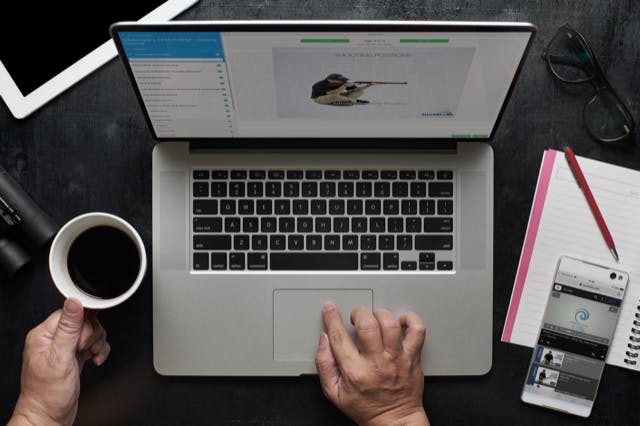
The straightforward way to prepare is our online firearms safety study course. It is $79 plus tax, it covers every concept on the written test, and it is broken into short sections with videos and review quizzes you can repeat as often as you like. It is included free with Silvercore Club membership. It does not replace the in-person course and no online course can, but walking in with the concepts already in your head means your whole attention on the day goes to the firearms in front of you.
We also keep a free playlist on our YouTube channel showing how to prove every action type you will be tested on. Watch it twice before class. If you would rather work off paper, physical copies of the CFSC and CRFSC manual are in our shop, and the same manuals are free to download from the Government of Canada publications site.
If you want a study order rather than just a resource list, we have written one out in how to study for the PAL exam, and you can pressure test yourself on our free PAL practice test before you commit to a course date.
Know ACTS and PROVE cold
If you take one thing from this page, learn ACTS and PROVE well enough to recite them in your sleep. They are the spine of the practical test and of everything you do with a firearm afterward.
A. Assume every firearm is loaded. You do not need to touch the firearm to do this. Even when someone you trust has told you it is unloaded, once it is in your hands it is your responsibility to check.
C. Control the muzzle direction at all times. This is the most important of the four. The firearm should always be pointed somewhere that, if it discharged, there would be no injury and minimal to no property damage.
T. Trigger finger off the trigger and outside the trigger guard. Unless you have made the conscious decision to fire, your finger goes clearly outside the guard, where the instructor can see daylight through it.
S. See that the firearm is unloaded. PROVE it safe.
Then PROVE:
- P. Point the firearm in the safest available direction.
- R. Remove all cartridges.
- O. Observe the chamber.
- V. Verify the feeding path.
- E. Examine the bore for obstructions, preferably with a cleaning rod or a bore observing device.
Notice that the first four letters of PROVE restate the S in ACTS. The genuinely distinct step is the E, examining the bore. It is also the step students skip most often on the practical. Do not skip it.
Muzzle direction is the rule that carries the others
Muzzle control is the cardinal rule. Jeff Cooper's version of it, never point the firearm at anything you are not willing to destroy, is worth carrying around in your head. If you break every other safety principle but hold that one, the firearm can still discharge and nobody gets hurt.
Point a firearm at yourself or at another person during your test and it is an automatic fail. There is no discussion and no second look.
On the trigger finger, off the trigger is not enough. Keep it clearly outside the trigger guard so the instructor can see daylight through it. Yes, in real life there are moments when a finger has to go on the trigger of a firearm that has been proven unloaded, such as removing a bolt or disassembling certain actions. For the test, keep it out and keep it visible.
Handle every action the instructor brings
Every so often a student decides they already know how every firearm works. Maybe they own the same make and model sitting on the table. Sometimes it behaves exactly the same. Often it does not. The training firearms have been rendered inert for course use, and that work can introduce small peculiarities. On top of that, these firearms have been run by hundreds of students before you, so the action can feel different from what you are used to.
Take your time and run every action type on the table: bolt, lever, pump, semi-automatic, break, and the restricted actions if you are taking the CRFSC. If something feels wrong, ask the instructor to walk you through it. That is what they are there for.
Ask questions
Do not be shy. You are there to learn, and asking is how learning happens. If you are wondering about something, several other people in the room are wondering the same thing and are too self-conscious to say so. Ask in front of the group, or pull the instructor aside on a break if it is something you would rather not raise publicly. Any instructor worth their salt welcomes it.
What the testing actually looks like
Each course has a written test of 50 multiple choice and true or false questions, and a practical handling test. You need 80% on each, graded independently.
On the written test, if a question does not make sense, mark it and move on. Work through everything else and come back. If it still does not make sense, ask your instructor for clarification. Your instructor is allowed to help you understand what a question is asking. They are not allowed to lead you to the answer or tell you which options are wrong. The time for teaching is during the course, not during the test, and a good instructor holds that line because their designation depends on it.
On the practical, slow down. Run ACTS and PROVE on every firearm you touch. A lot of students find that saying the steps out loud keeps them from skipping one, and it gives the instructor a window into your thinking. Saying “pointing in the safest available direction, removing the cartridges, observing the chamber, verifying the feeding path, examining the bore” as you do each step costs you nothing and catches mistakes before they cost you marks.
One reminder, because we correct it on the phone every week. The CFSC and the CRFSC are non-firing courses. There is no live fire, no live ammunition in the room, and no ear protection needed. Everything is taught and tested on inert training firearms and dummy ammunition. Live fire comes after your licence, in marksmanship training such as Rifle Marksmanship Fundamentals.
Where people actually lose marks
From the instructor side of the table, the failures follow a short and repetitive list.
- Pointing the firearm at themselves or someone else, even for a moment, usually while transitioning between actions. Automatic fail.
- Trigger finger creeping inside the guard during handling.
- Forgetting to examine the bore. The E in PROVE is the most missed step on the practical.
- Loading before the muzzle is pointed somewhere safe.
- Rushing. Almost every handling failure traces back to a student trying to get through it quickly rather than correctly.
- Skipping preparation entirely and trying to absorb the whole course over a weekend.
There is a second pattern worth naming. Students with prior firearms experience sometimes treat the course as a formality, and they are often the ones who struggle at test time. Some of what is on these tests is specific to the courses themselves. A lifetime around firearms does not cover it. I grew up around them and I still learn something new on a regular basis.
What the day looks like
Our home classroom is Silvercore Classroom Delta at #115-7198 Vantage Way, Delta BC V4G 1K7. We also teach at LaSalle College Vancouver, 2808 Bradfield Court (across from Renfrew SkyTrain station), at The Range Langley at 9938 201 Street, and at other locations across the Lower Mainland and on Vancouver Island.
The RCMP standard caps class size at twelve students per instructor, requires inert training firearms and dummy ammunition only, and does not permit any portion of the course to be skipped. In practice the day runs instruction, then hands-on work with the training firearms, then testing. The CFSC is a minimum of eight hours of classroom instruction, not counting breaks or exams. The CRFSC is a minimum of six, dropping to four when it is delivered within seven days of the same provider's CFSC. The two cannot be taught on the same day.
Bring yourself, something to write with, and a lunch. Everything else is supplied. Do not bring a firearm or any ammunition.
If you do not pass
You can retake a failed exam after a minimum of one day. If more than seven days pass before the retest, you have to retake the whole course, and the same applies if you fail the retest. Our retest fee is $30, and it is free if you purchased our online study course.
Plan around this rather than gambling on it. Prepare properly and you will not have to think about it.
After you pass
Your instructor issues a course report showing successful completion. That report, not a certificate on the wall, is what goes with your PAL application to the RCMP. Until that licence is in your hand you cannot take possession of a firearm or buy ammunition.
Passing is the first milestone, not the destination. What comes after is where the actual competence gets built: range time, marksmanship instruction, hunting, and people to learn from who have been at it longer than you have. The full picture of both courses and how they fit together is in the CFSC and CRFSC complete guide.
Where the Silvercore Club fits
The Silvercore Club is $59 CAD a year. Membership includes free access to our Silvercore branded online courses, including the CFSC and CRFSC study course, $5 million in third-party liability insurance, and partner discounts on optics, ammunition and gear. The Club is RCMP approved as an ATT club, which matters if you took the restricted route and need an Authorization to Transport. It serves members across Canada and internationally, not BC alone.
If you are treating your licence as the start rather than the finish, joining is the logical next step. You can sign up at silvercore.ca/club.
Travis Bader, Silvercore Outdoors


